Whitehall's Winter Season Begins With How Palm Beach Was Designed
November 19, 2026
November 19, 2026
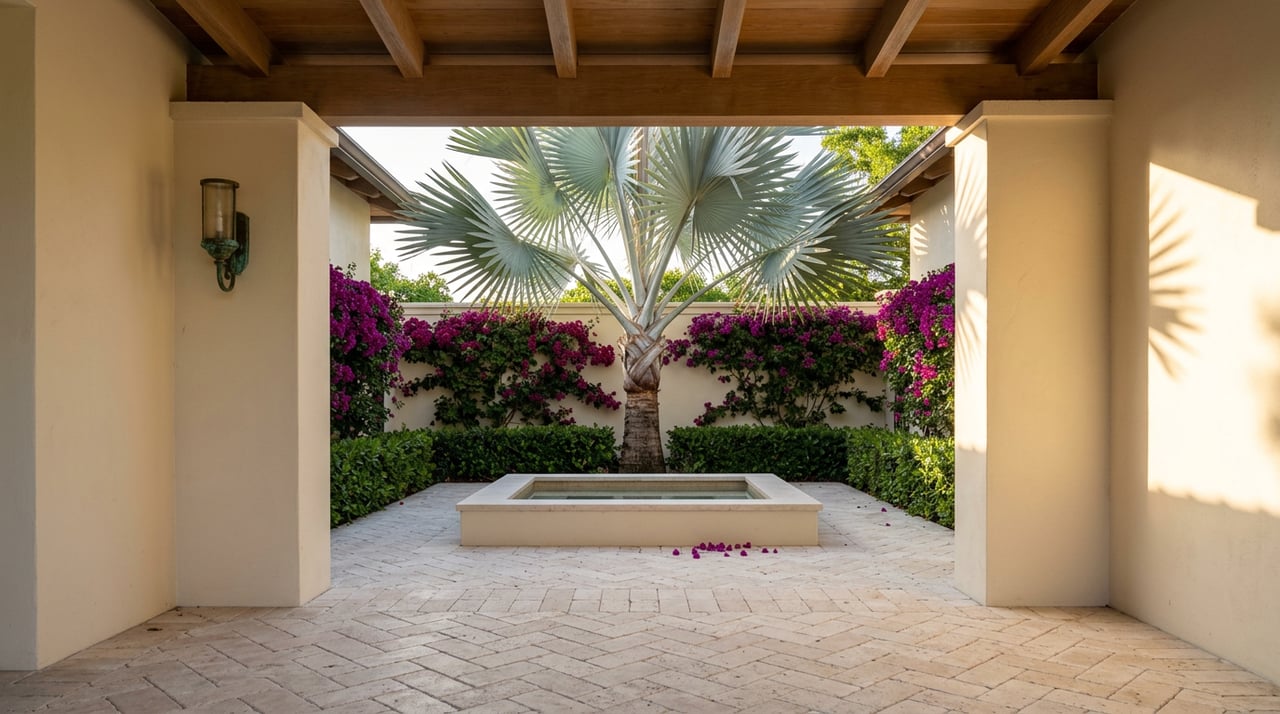
"The change is just night and day," Phillip Estlund, the Flagler Museum's director of facilities, told the Palm Beach Daily News in late September. "There's so much more light." He meant the central open-air courtyard at Whitehall. All of its awnings came down this fall while the building was prepared for tenting, and the museum calls that the first step toward an eventual refresh of the courtyard.
So the house goes into the 2026-27 season with an open, sunlit courtyard. The exhibition that opened this week asks what that courtyard and everything around it were built to say. Its answer is that Palm Beach was designed on purpose, from a borrowed model, and this year's work on the building makes Whitehall the easiest place to read that design.
America Takes the Stage: From the White City to Whitehall opened November 17 and runs through May 30, 2027. The guest curator is Mosette Broderick, an author, historian and professor of architecture at New York University. The show begins in the summer of 1893. That year Chicago opened the World's Columbian Exposition, a "White City" of neoclassical buildings and manicured grounds designed by Daniel H. Burnham and Frederick Law Olmsted. Over the course of the fair, 27 million people came to see it.
The museum's exhibition page puts its premise plainly: "Henry Flagler was watching." About a decade later he brought that vision south. His railroad and grand hotels turned Palm Beach into a resort for wealthy northern travelers, and in 1902 he built Whitehall as his permanent residence, "in the architectural language of the Fair itself." The museum describes both places as exercises in curated fantasy. Each used architecture and landscape to make raw land feel timeless and European while staying American. It calls Whitehall the only permanent monument to that moment in American cultural history. Northern Trust provided lead support for the exhibition.
The fair itself was built to be temporary, and most of it was gone within a year of closing. PBS host and Chicago historian Geoffrey Baer opened the exhibition's lecture program on November 18. His talk connected the fair to the City Beautiful movement, and the museum's description says that legacy "can still be seen at Whitehall and throughout Palm Beach."
Two more talks extend the argument. On Wednesday, December 9, Gerald Larson, professor emeritus of architecture at the University of Cincinnati and author of The Skyscraper and the White City, will describe the fair as it might have looked. Architect John Wellborn Root first planned a colorful, architecturally varied fairground facing Lake Michigan. Root died suddenly in 1891, and his partner Burnham built the unified white classical ensemble instead. Larson closes with a question that matters on this island: if Root had lived, would he have become the "Father of American city planning" instead of Burnham? Had he lived, Flagler might have gone home in 1893 with a different model in mind.
On Tuesday, January 19, London-based design critic Alice Rawsthorn, a former Financial Times correspondent and New York Times design columnist, carries the story to the present. She will talk about how the fair's vision of the future still bears on design, architecture and technology. Each lecture begins with cocktails at 5:30 p.m., and the talk starts at 6:00.
The exhibition makes the argument with archives and loans. This year's repairs made it in the building itself. According to the Palm Beach Daily News, crews spent the off-season replacing the flat roofs on the south and east porticos. They also worked on the flat roof of a two-story section on the west side, which survives from the 1925 hotel addition.
That section explains a stretch of the house's history that many people skip. Flagler built Whitehall in 1902 for his third wife, Mary Lily Kenan Flagler. After her death the building became a hotel, which operated until the late 1950s. The hotel tower's 11 upper floors were demolished in 1963. The museum itself opened in 1959, through the vision of Flagler's granddaughter, Jean Flagler Matthews. When roofers opened the old hotel section, they found that its roof had been laid directly over the original tiles of the Whitehall Hotel's third floor, Amanda Skier, the museum's director and CEO, told the paper. Estlund described matching the old room and hallway layouts to archival images.
The dining hall had its own discovery. In the summer of 2024, preservationists found that dark varnish on the room's woodwork had hidden honey-colored West Indian satinwood installed when the mansion was built. The restoration removed the stain and refinished the coffered ceiling to match the wood's color and grain, as the Palm Beach Daily News reported at the time. In 2025 the Florida Trust for Historic Preservation honored the Whitehall Dining Room in its Restoration, Rehabilitation or Adaptive Use category.
That same project led to this fall's tenting. Termites had gone after the ash wood behind the satinwood, though the satinwood itself was unaffected. The damaged ash was replaced, and the museum decided to fumigate the whole building for the first time since 1989. Before the tent went up, crews moved interior plants to the southern grotto or an off-site greenhouse. They built scaffolding around the large marble pots at the entrance, wrapped the balconies in rigid foam and trimmed the courtyard plantings. Taking down the awnings was part of that preparation.
Other work is harder to see. The museum is replacing one of its chillers, plans to redesign its climate-control and air-conditioning systems later, and is doing a minor marble restoration on the east portico. "There's a lot of investment that I don't think is always visible to everyday visitors," Skier told the paper. Skier took over as executive director in February 2025, succeeding John Blades.
The holiday calendar carries the same idea of a curated fantasy, this time in flowers. On Sunday, December 6, from 3:00 to 5:00 p.m., Flagler's youngest descendants will light the 16-foot Grand Hall Christmas tree. The afternoon includes seasonal instrumental music, a choir, a selection from The Nutcracker by the Paris Ballet Company, and a visit from Santa and Mrs. Claus. The lighting is for members at the Family/Dual level and above.
The evenings open to everyone later in the month. Holiday Evening Tours run December 18 through 23 and again December 26 and 27, with entry at 6:00, 6:20, 6:40 and 7:00 p.m. Tickets are $65 for adults and $35 for children. A docent leads each group through the first floor. Carolers sing, and the evening ends with refreshments on the Front Portico. This year every historic room on the tour has a floral installation inspired by HBO's The Gilded Age.
During the same days, December 18 through 27, Fleurs de Villes: THE GILDED AGE fills the museum with 15 mannequins dressed in thousands of fresh flowers. Each one is based on a character, costume or theme from the series, and the show comes with general admission. General admission is $28 for adults 13 and older and $14 for children ages 6 to 12. Children five and under get in free, and members get in free, according to the museum's visitor information.
Mid-December also has music. On Wednesday, December 16, flutist Emi Ferguson and pianist Peter Dugan perform in the Flagler Museum Music Series. The museum ties this season's concerts to the exhibitions and the house. Tickets are $95 for nonmembers and $75 for members at the Individual through Patron levels. Visionary and Flagler Circle members attend free, and valet parking is included.
January keeps the White City as its subject. The New York Philharmonic Brass Quintet plays Thursday, January 14, and Rawsthorn lectures five days later. In February the museum turns from the buildings of the era to its jewels. Gilded Age Jewelry: The Making of Modern Luxury runs February 18 through May 2, 2027, with more than 150 objects, including loans from major jewelry houses and museums.
Its lectures follow the same thread. On March 3, Katherine Howe, co-author with Anderson Cooper of Vanderbilt: The Rise and Fall of an American Dynasty, and T.J. Stiles, Pulitzer Prize-winning author of The First Tycoon: The Epic Life of Cornelius Vanderbilt, present Capital and Culture. On March 31, Christopher Young and Campbell Mobley speak on An American Style: Tiffany, the Flaglers, and the Gilded Age. On April 14, Carol Woolton and guests close with The Making of Modern Luxury: Great Jewels and the Stories Behind Them. The rest of the music series continues through spring, with The Cleveland Orchestra's Blossom String Quartet on February 28, Kiron Atom Tellian on March 23, and Greg Zelek with Alvaro Bermudez on April 13.
The dates to note through January:
For a self-guided visit between events, the museum's free digital guide on Bloomberg Connects has audio tours, high-resolution images of the collection and interactive floor maps. The guide launched in August 2025. For more on the island around the museum, see our Palm Beach neighborhood guide.
At Sharon Sweet, we read buildings the way this season reads Whitehall: as finishes, structure and stewardship, all of which shape value. If you own on the island and wonder what your building's original details or recent common-area work say about your residence, we would be glad to walk through it with you. Schedule a private consultation.
Stay up to date on the latest real estate trends.
With unmatched creativity, negotiation skills, and dedication, Sharon is ready to guide you through every step of your real estate journey.
Sharon Sweet
Address 340 Royal Poinciana Way Ste M314 Palm Beach FL 33480